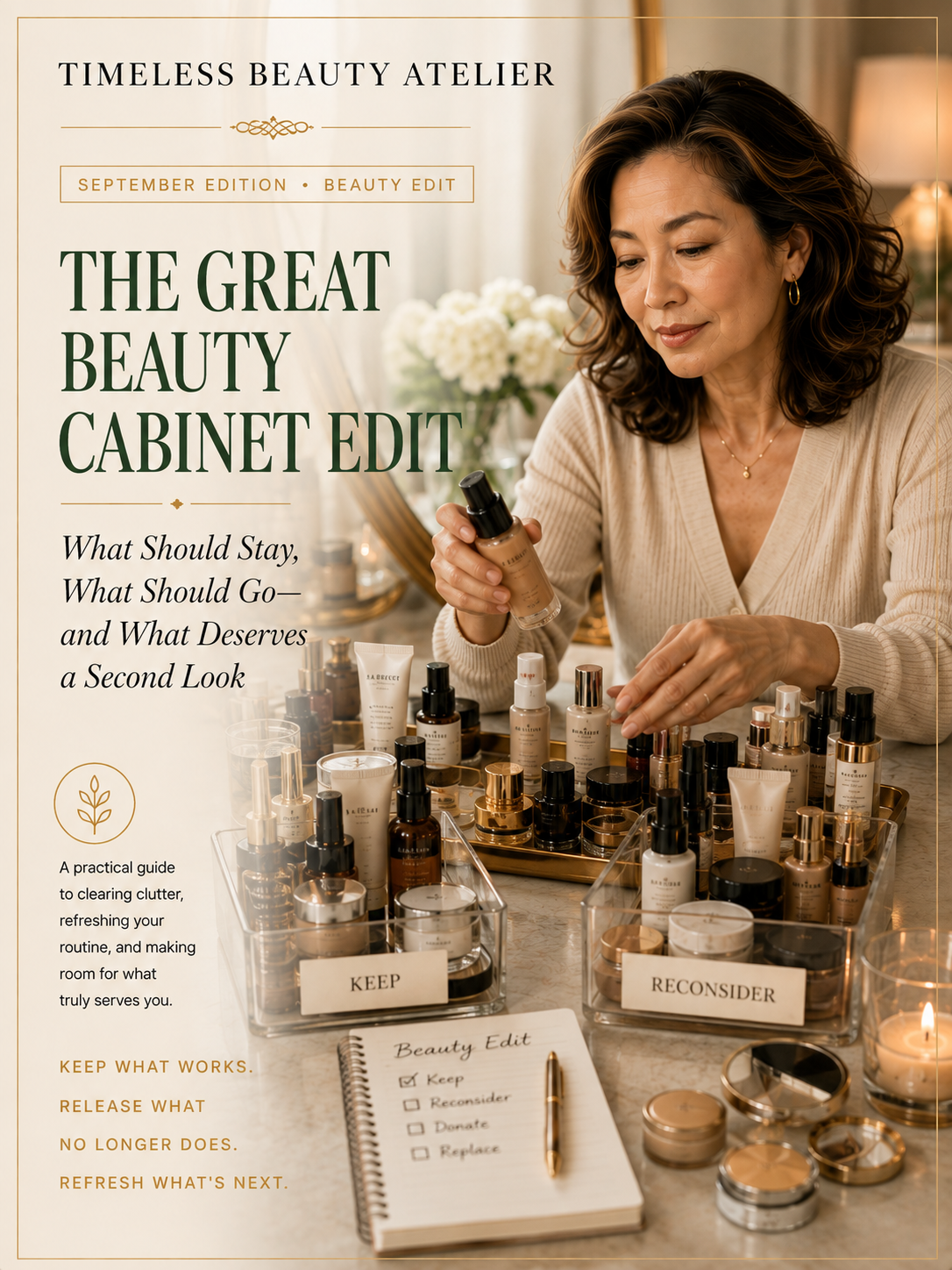
The Great Beauty Cabinet Edit: What Should Stay, What Should Go?
THE SEASON OF RENEWAL
The Great Beauty Cabinet Edit
What Should Stay, What Should Go—and What Deserves a Second Look
There is a particular kind of optimism involved in buying a beauty product.
The lipstick that will become the perfect lipstick.
The serum that earns a permanent place beside the sink.
The foundation that finally gets everything right.
The eye shadow palette whose twelve beautiful shades we fully intend to use—even though experience suggests we'll fall hopelessly in love with two.
And then, somehow, the collection grows.
A moisturizer gets pushed behind a newer moisturizer. Three nearly identical lip colors begin sharing a drawer. A mascara survives considerably longer than anyone intended. Samples multiply. Brushes wait patiently for the cleaning they were promised last Sunday.
Before long, the beauty cabinet stops being a collection of things we use and becomes a history of things we've tried.
September's Season of Renewal offers a wonderful opportunity to change that.
Not with an enormous purge.
Not by throwing away perfectly good products because someone on social media told us our beauty routine needs a “detox.”
Instead, we're going to edit.
Thoughtfully.
Because a beautifully edited beauty collection isn't necessarily small.
It's simply filled with things that deserve to be there.
Begin With Everything You Own
Yes.
Everything.
Skincare from the bathroom.
Makeup from the vanity.
That lipstick in your handbag.
The second lipstick in your other handbag.
And the three others you just remembered are downstairs.
Bring together the products you actually use and the ones you've quietly forgotten.
Seeing everything in one place tells you something that looking inside individual drawers never will.
You may discover four moisturizers.
Six mascaras.
Three foundations in slightly different shades.
Enough lip products to open a respectable boutique.
That's not a moral failing.
It is simply information.
And information is where a good edit begins.
Create Five Categories
Instead of immediately deciding KEEP or THROW AWAY, make five groups:
LOVE & USE
MAYBE
NEEDS ATTENTION
NO LONGER WORKS FOR ME
TIME TO GO
That middle ground matters.
A lipstick doesn't need to go simply because you haven't worn it recently.
And an expensive serum doesn't automatically deserve to stay simply because it was expensive.
We're assessing each product on its condition, usefulness and place in your routine—not the guilt associated with buying it.
First Question: Is It Still Safe and Pleasant to Use?
Cosmetics and skincare do not remain unchanged forever.
Air, moisture, repeated opening and closing, fingers, applicators and time can all affect products after they're opened.
One useful clue is the Period After Opening symbol, often called the PAO symbol.
Look on the container or packaging for a tiny image resembling an open cosmetic jarwith something such as:
6M
12M
24M
The number indicates the manufacturer's recommended period of use after opening—six months, twelve months, twenty-four months and so forth.
Not every product uses the same type of date labeling, and the PAO symbol shouldn't be treated as the only consideration. How a product has been stored and whether its appearance, odor or consistency has changed also matter.
The FDA notes that cosmetics can deteriorate over time and that consumers should follow product-specific storage and use directions. Eye-area cosmetics deserve particular care because of their proximity to the eyes.
So don't turn your September edit into an expiration-date guessing contest.
Look at the actual product.
Use Your Senses
A product can sometimes tell you that its best days are behind it.
Ask:
Has the smell changed?
If something that once smelled neutral suddenly smells strange, rancid or simply wrong, pay attention.
Has the texture changed?
Has a cream separated?
Has a liquid become unusually thick?
Has something become grainy when it wasn't before?
Has the color changed unexpectedly?
Some formulations naturally shift somewhat over time, but a substantial unexplained change deserves attention.
Is the packaging compromised?
Cracked container?
Broken pump?
Loose cap?
Product exposed to contamination?
Does it behave differently?
If a familiar product suddenly applies or performs very differently, investigate rather than assuming your technique is the problem.
When you're genuinely uncertain whether a product is still appropriate to use, the safest choice may simply be to replace it.
Your face isn't the place to conduct an archaeological experiment.
Pay Particular Attention to Eye Products
The eye area deserves a stricter edit.
Mascara and other products used around the eyes can become contaminated during normal use, which is one reason manufacturers and health authorities recommend paying close attention to storage, hygiene and replacement instructions.
Never add water or saliva to mascara to extend its life.
Don't share eye cosmetics.
And if you've had an eye infection, follow appropriate medical guidance about products used around the affected area.
September assignment:
Find every mascara you own.
Every single one.
If you can't remember when you opened one, that's useful information in itself.
A simple habit going forward is to write the opening month on the tube or keep it in your phone.
Tiny habit.
Much less guessing.
Second Question: Do I Actually Use It?
Now we leave product condition and enter the far more interesting territory of human behavior.
Pick up each product and ask:
When did I last use this?
Not:
“When might I use this?”
That's how a glitter eye shadow purchased for an imaginary gala in 2019 manages to secure lifetime residency.
When did you actually use it?
Then ask:
Why don't I use it?
The answers are revealing.
Maybe the fragrance bothers you.
Maybe the foundation is too heavy.
Maybe the lipstick color doesn't make you feel good.
Maybe the packaging is annoying.
Maybe the moisturizer pills beneath your makeup.
Maybe there's absolutely nothing wrong with it—you simply prefer something else.
That's enough.
A product doesn't have to be terrible to be wrong for you.
Third Question: Am I Keeping It Because It Was Expensive?
Ah.
The luxury-product guilt drawer.
You spent good money on it.
Therefore it sits there.
Unused.
For eighteen months.
As though keeping it somehow refunds the purchase.
It doesn't.
The money was spent when you bought the product.
Keeping something you dislike doesn't recover the cost.
What it can do is teach you something about your preferences.
Perhaps you don't enjoy heavily fragranced skincare.
Maybe you consistently prefer lighter foundation.
Maybe you buy palettes but actually prefer individual eye colors.
Maybe you love looking at dramatic lipstick but rarely enjoy wearing it.
That's valuable knowledge.
Your unsuccessful purchases can make you a much smarter beauty shopper.
Fourth Question: How Many Versions of This Do I Need?
Duplicates are not inherently bad.
Having a favorite lipstick in your handbag and another at home can be wonderfully practical.
Having six moisturizers open simultaneously when you consistently use one may be less so.
Look for categories where products have accumulated:
Cleansers.
Serums.
Moisturizers.
Foundations.
Concealers.
Mascaras.
Lipsticks.
Palettes.
Fragrance.
Then ask:
Which one do I reach for first?
That's often your answer.
Your favorites reveal themselves through use.
Don't Forget the Tools
Your beauty cabinet isn't only bottles and compacts.
Look at:
Makeup brushes.
Sponges.
Applicators.
Tweezers.
Eyelash curlers.
Cosmetic bags.
Hairbrushes and combs.
Reusable skincare tools.
Some don't need replacing.
They need cleaning.
Product buildup on brushes and sponges can affect both hygiene and makeup application. Follow the manufacturer's cleaning instructions for reusable beauty tools and allow them to dry appropriately before use.
And while you're there, wipe out the drawer.
Clean the makeup bag.
Wash the container holding your brushes.
Renewal sometimes looks suspiciously like housekeeping.
Now Comes the More Interesting Edit
Once you've removed products that are no longer appropriate to use and identified things you simply don't like, look at what remains.
This is where September's beauty reassessment becomes useful.
Ask yourself:
Does this collection reflect the beauty routine I have now?
Maybe your skin has become more comfortable with a different foundation finish.
Perhaps you're wearing less makeup—but enjoying color more.
Maybe skincare has become more important to you.
Perhaps you've discovered that you adore lipstick and have absolutely no intention of becoming a minimalist.
Good.
This isn't about owning fewer things for the sake of owning fewer things.
It's about removing the noise so you can see what you genuinely enjoy.
The “Maybe” Basket
I strongly recommend this.
If you can't decide about something, don't force the decision.
Put those products together in a separate basket or drawer.
Then give yourself a defined period to revisit them.
If you find yourself retrieving something from the basket because you genuinely wanted it—excellent.
It has earned its way back.
If weeks pass and you completely forget the basket exists, that tells you something too.
This turns decluttering into observation rather than punishment.
What Not to Do
Don't use this exercise as an excuse to immediately replace everything you remove.
Otherwise:
Beauty Cabinet Edit → Beauty Cabinet Shopping Spree
and by October we'll be right back where we started.
Live with the edited collection for a little while.
Notice what's actually missing.
Perhaps nothing is.
If there is a genuine gap, you'll now be able to shop for that specific need rather than buying another product because its packaging whispered sweet nothings to you from a display.
Build Your Working Beauty Wardrobe
I like thinking of beauty products as a wardrobe.
A good wardrobe contains staples.
Favorites.
A little indulgence.
Something glamorous.
Something practical.
And perhaps a few things that exist simply because they make you happy.
Your beauty collection can work exactly the same way.
You might have:
Your everyday essentials
Products you use consistently.
Your treatment products
Items serving specific skincare goals.
Your beauty signatures
The lipstick, fragrance, blush or liner that feels unmistakably you.
Your occasion pieces
Products you don't use daily but genuinely use when the moment calls for them.
Your seasonal additions
The textures and colors you enjoy bringing forward as the weather and your mood change.
Everything doesn't need to earn its place through necessity.
Pleasure counts.
Beauty is allowed to be fun.
Before You Buy Something New
September gives us one final question to carry into the season ahead.
Before adding another beauty product, ask:
What job is this product coming here to do?
Is it replacing something?
Solving a problem?
Adding a color you genuinely don't own?
Supporting something your skin currently needs?
Or is it simply something beautiful you consciously want?
Any of those can be perfectly legitimate reasons.
The important part is knowing the answer.
Because intentional buying produces a beauty cabinet filled with choices.
Unintentional buying produces clutter.
The Atelier Edit
When you're finished, your cabinet doesn't need to look like a minimalist Pinterest photograph.
It needs to look like you.
Keep the lipstick that makes you feel fabulous.
Keep the perfume you save for special evenings.
Keep the extravagant cream you genuinely adore using.
Keep the products that work.
Clean the tools worth keeping.
Replace what is no longer appropriate to use.
Release what you continually avoid.
And reconsider the things you've been keeping out of habit.
Because a beauty edit isn't really about having less.
It's about making room for what serves you now.
That is renewal.
— Timeless Beauty Atelier
Enjoyed this article?
Continue exploring our complimentary beauty resources created especially for women over 50.
The 5-Minute Face That Still Looks Polished After 50
Discover a beautifully simple makeup routine designed specifically for mature skin.
7 Beauty Mistakes That Add Years to Your Appearance
Learn seven common beauty habits that may unintentionally age your appearance—and the simple changes that can make a noticeable difference.
Continue Your Timeless Beauty Journey
Join the Timeless Beauty Atelier Society for beauty tips, skincare insights, exclusive offers, and monthly beauty inspiration designed for women who appreciate timeless elegance.
